Tag: WaiterOne COS

  • What exactly is a hospitality cash register system?

    A full lunch shop at 12.15 pm is often the moment when you immediately notice whether your cash register cooperates with you or works against you. Orders have to go to the kitchen quickly, tables have to beat, staff are not allowed to search and at the end of the day you just want to know what has been sold. That’s exactly where the question begins: what is a hospitality checkout system?

    A hospitality cash register system is the central system with which you enter orders in your business, manage accounts, process payments and keep a grip on your daily operations. So it is much more than a digital replacement for an old-fashioned cash register. In practice, it is the point where service, bar, kitchen, management and reporting come together.

    What is a hospitality cash register system in practice?

    In a store, checkout is often the main task of a cash register system. In the hospitality industry, it is different. There, the process usually begins when taking an order at the table, at the bar, at a collection point or via a kiosk. That order should immediately end up in the right place, for example on a kitchen screen or at the bar, without notes lying around or misunderstandings arising.

    A good hospitality cash register system helps you with the entire route from order to payment. It records what is sold, at what time, by which employee, on which table or in which sales channel. At the same time, it makes reports, tracks sales and provides insight into your busy moments, best-selling products and team performance.

    That’s also where the difference is with a simple cash register app or standard payment system. A real hospitality cash register system is built for pace, crowds and multiple processes at the same time. That makes it relevant for restaurants, cafes, lunchrooms, food trucks, ice cream parlors and festival concepts.

    Which functions belong to a hospitality cash register system?

    The basics are simple: you want to be able to order and pay. But in the hospitality industry, the practice is just a little less simple. Splitting a table, putting a round on the bill, passing a product without onion to the kitchen or immediately seeing which tables are still open – these are functions you need on a daily basis.

    Most modern hospitality cash register systems therefore offer features such as table management, mobile order recording, linking to kitchen or bar, different payment methods, reporting and user rights for employees. Often there are also inventory management, pick-up and delivery options, reservations and customer orders.

    Not every company needs everything. A food truck has different requirements than a restaurant with a large terrace. An ice cream parlor wants speed at the counter, while a bistro has a lot of table management and aisle system. Therefore, the best question is not only what a hospitality cash register system is, but also what your business should be able to do with it every day.

    Order, pass on and pay without detours

    The core of a good system is speed. Employees must be able to enter an order directly on an iPad, iPhone or fixed cash register. That order must be visible in the kitchen or at the bar without additional actions. After that, payment should go just as smoothly, whether per table, per person or partly cash and partly pin.

    If a system is slow or cumbersome at this point, it costs immediate turnover and rest. Especially at peak times, you don’t want menus that are too deep hidden or screens that staff have to click through as if they were filling out a tax form.

    Insight into your case

    A catering cash register system is also a steering instrument. You can see what’s going fast, when it’s busy, which articles make margin and where processes get stuck. This is useful for large chains, but also for smaller entrepreneurs who need to focus on costs and staff deployment.

    With good reports, you have to do less on feeling. You can see faster if a lunch deal works, if Sunday afternoon is really profitable and which employee makes a striking number of corrections. That kind of insight helps to adjust faster.

    Why are hospitality businesses switching to modern cash register systems?

    Because old systems are often expensive, cumbersome and limited. Many entrepreneurs remember it: closed hardware, high purchase costs, additional licenses per device and a phone call to a supplier for every small change. That model is less and less suited to hospitality that wants to work flexibly.

    Modern hospitality cash register systems often run on well-known hardware such as iPads and iPhones and work cloud-supported. That makes them more mobile and usually easier to use. New employees need less explanation and expansion is faster. For a terrace, extra point of sale or event, you don’t have to go straight into a completely new route.

    That doesn’t mean every modern system is automatically good. Some solutions look sleek, but lack features that are crucial in practice. Other systems are cheap in the base, but add so much per device, per module or per additional screen that the advantage quickly disappears. That is precisely why it pays to look beyond just the entry price.

    What should you pay attention to when choosing one?

    The first test is simple: does the system connect to your way of working? Not on a demo situation, but on a busy Friday night, a full terrace or a takeaway moment when everything happens at the same time.

    Look at ease of use. Can staff work with it quickly without long training? Is the screen logically arranged? Can you easily customize products, tables and price groups? The faster your team can get along with it, the fewer errors and delays you get.

    Also pay attention to the total cost. Not only the subscription price, but also hardware, installation, support and any surcharges for additional devices or features. A system that seems cheap can still be expensive in a year.

    Reliability is at least as important. A catering cash register system must remain stable, especially during crowds. Therefore, ask how the system handles internet outages, updates and support. You don’t want a supplier who is mainly available at times when you are closed.

    Does it suit your type of hospitality?

    Not every system is equally suitable for every concept. A quick service business wants as few actions as possible per order. A restaurant needs table plans, courses and bill splitting. A festival concept wants to be able to scale up speed, multiple points of sale and temporarily.

    That is why industry-specific practical experience is important. A supplier who really understands the hospitality industry builds functions based on use in the business, not just based on technology. You notice that in small things that are big in practice.

    What does a good hospitality cash register system yield?

    The biggest advantage is usually not technical innovation, but rest in the operation. Less miscommunication between service and kitchen. Fewer errors on receipts. Faster checkout. Less time spent on research after closing.

    In addition, it often provides an immediate financial benefit. Faster turnaround time means more order processing. Better insight means smarter shopping and planning. And if you don’t have to make a high investment in expensive, closed hardware, there’s more room for the business itself.

    For many entrepreneurs, profit is also in flexibility. You can scale more easily, add additional sales channels, or customize processes as your concept changes. That is useful if you have seasonal crowds, temporarily run a second location or want to start with takeaway, kiosk or customer orders.

    What is a hospitality cash register system worth if it works really simply?

    More than entrepreneurs sometimes think. A system is often judged on functions, but in practice it is all about workability. If staff enter orders quickly, if the kitchen immediately sees the right information and if you can view reports without hassle, you will notice the difference every shift.

    That is precisely why many hospitality entrepreneurs no longer choose the toughest or most expensive solution, but a system that can do a lot without becoming complicated. That is also the reason that platforms such as WaiterOne are gaining ground: a lot of functionality, clearly priced and built for how hospitality really runs.

    The core: it should make your business easier

    The best explanation for the question of what is a hospitality cash register system is ultimately very practical. It is the system that ensures that ordering, passing on, checkout and managing do not pass each other by, but together form one working process.

    If you still work with an outdated cash register, loose notes, unclear reports or a system that doesn’t really make anyone happy, that’s usually not a minor inconvenience. It slows down your surgery a bit every day. And in the hospitality industry, that’s all that counts.

    So don’t choose the system with the longest feature list, but the system that immediately saves time on the floor, gives an overview and remains affordable. That really helps you on a busy Saturday night.
  • Revolutionizing Restaurant Efficiency: Why WaiterOne is the Ultimate iPad POS for the Americas and Beyond

    1. Introduction: The Modern Challenges of Hospitality Management

    Running an independent restaurant, cafe, or bar today is a high-stakes balancing act. Between rising labor costs and the need for faster service, traditional Point of Sale (POS) systems often become a bottleneck rather than a tool. Many legacy systems are overly complex, prohibitively expensive, and prone to total failure the moment your internet connection flickers.

    WaiterOne was designed to disrupt this cycle. Built specifically for independent venues, it leverages the power of the Apple ecosystem to provide a fast, dependable, and remarkably affordable POS solution. Most importantly, WaiterOne has partnered with payment leaders to lower the barrier to entry: the software is now available for free when integrated with SumUp in 34 countries, making it the most accessible professional-grade system on the market.

    Adopting WaiterOne provides three primary benefits for your venue:

    • Cost Efficiency: Massive savings through a free entry point with SumUp or a low-cost, all-inclusive subscription.
    • Ease of Use: An intuitive interface that slashes staff training time and reduces order errors.
    • The Client Ordering System (COS): Advanced “Scan-to-Order” technology that empowers guests and reduces front-of-house labor.

    2. What is WaiterOne? A Native Powerhouse for iPad

    While many modern POS systems are “web apps” that run inside a browser—leaving you vulnerable to slow load times and internet outages—WaiterOne is a native iOS/iPadOS application. This means the software lives on your device. It offers blazing speed and total reliability; even if your internet fails, your business doesn’t. Your data is stored locally, ensuring service remains uninterrupted in any environment, from busy city bistros to remote food trucks.

    WaiterOne Core Architecture

    The system uses a “Hub and Spoke” model, turning your main iPad into the central command center of your venue.

    Main iPad (The Hub)Peripheral Devices (The Spokes)
    Local Server: Acts as the central brain and local SQL database.WaiterOne Remote: Staff iPhones or iPods used for tableside ordering.
    Control Center: Manages all traffic to and from peripherals.Printers: Ethernet, Wi-Fi, or Bluetooth receipt and kitchen printers.
    Back Office: Configure menus, staff, and tax settings directly.KDS: iPads used as digital Kitchen Display Systems for prep stations.
    Sync Engine: Pushes real-time data to the Cloud Dashboard.Kiosk: Self-service stations for guest-led ordering.

    Hardware & Network Setup WaiterOne creates a “well-oiled machine” by establishing a stable local network. All devices the main iPad, kitchen printers, and handheld remotes connect to a single local Wi-Fi router. This setup removes dependency on external servers for daily tasks, guaranteeing that your staff can fire orders to the kitchen instantly, regardless of external web traffic.

    3. The Client Ordering System (COS): Putting Power in the Customer’s Hand

    WaiterOne evolved its ordering technology by listening to business owners. While table-mounted iPads were once the trend, they proved expensive and hard to maintain. We pivoted to the Client Ordering System (COS): a universal web app that utilizes the device your customers already carry—their own smartphone.

    Key Benefits of COS:

    • No App Downloads: Guests scan and order instantly through any mobile browser; no friction, no App Store required.
    • Universal Access: The system works on PCs, Macs, and smartphones, making it perfect for both in-house dining and remote pick-up or delivery.
    • Secure & Effortless: Clients use their own data or your guest Wi-Fi to browse your real-time menu, synced directly from your iPad.

    The Customer Ordering Journey

    1. Scanning the QR Code: The customer scans a unique code at their table or on a takeaway flyer.
    2. Browsing the Synced Menu: Guests see high-resolution images and descriptions synced instantly from your POS.
    3. Placing Orders and Payments: Customers select items and pay online securely via Mollie or at the table.
    4. Service Interactivity: Integrated Service Buttons allow guests to call a waiter or request the bill directly from their phone.
    5. Instant Arrival: Orders appear on the WaiterOne iPad and kitchen printers in a split second.

    4. Advanced Features to Supercharge Your Venue

    WaiterOne provides a suite of high-performance tools designed to eliminate the “high cost of error” and streamline your workflow.

    • Kitchen Display System (KDS): Replace messy, expensive paper tickets with digital screens. The KDS reduces food waste caused by lost dockets and allows staff to “Prepare,” “Service,” and “Close” tickets digitally for maximum organization.
    • WaiterOne Remote: Turn any staff iPhone or iPod into a mobile ordering station for free. This allows your team to stay on the floor, engaging with guests while firing orders to the bar or kitchen instantly.
    • Smart Modifiers & Courses: Reduce costly mistakes with automatic prompts (e.g., steak temperatures). Use “Courses” to create a cleaner, prioritized workflow for the kitchen, ensuring starters and mains are grouped and fired according to your kitchen’s rhythm.
    • Reservations & Waitlist: Manage your floorplan with an integrated booking system. Track party sizes and wait times, and link guests to client profiles to recognize your “regulars” and their preferences.

    5. Seamless Payments and Global Flexibility

    WaiterOne is built to serve the global market, specifically addressing the legal and operational needs of the Americas and Europe.

    • Integrated Payments: Beyond the SumUp partnership, WaiterOne integrates seamlessly with Zettle and Mollie. With the SumUp integration, the software is free to use in 34 countries, providing an unbeatable entry point for new businesses.
    • European Legal Compliance: We ensure you stay compliant with local tax authorities. WaiterOne includes specific integrations for Fiskaly (TSE) in Germany and FDM (the “BlackBox”) in Belgium.
    • Multilingual Support: Break language barriers with software translated into 18 languages, including Spanish, Dutch, and German, allowing for an international staff and client base.
    • VAT/TAX Flexibility: Easily manage multiple tax levels. Configure different rates for “dine-in” vs. “takeaway” (VAT 1 vs. VAT 2) to ensure perfect local compliance.

    6. Transparent Pricing: No Hidden Costs

    We believe in honest pricing that helps independent businesses grow. Our subscription model is all-inclusive, meaning you never pay extra for the “extras.”

    Pricing Snapshot

    • SumUp Offer: Software is FREE when integrated with SumUp (available in 34 countries).
    • Standard Subscription: Approximately $24/month or €20/month when paid yearly.
    • All-Inclusive: Updates, Support, Remotes, KDS, Cloud Dashboard, and COS are all included at no extra cost.

    7. Getting Started: The Path to Smarter Ordering

    You don’t need an IT degree to modernize your venue. Follow this Quick-Start Checklist to begin:

    • Download: Get WaiterOne from the Apple App Store.
    • Configure: Set up your Groups and Buttons in the “Data” tab.
    • Activate COS: Enable the Client Ordering System in Settings and choose your menu groups.
    • Upload: Click “Upload to the Cloud” to sync your menu to the web app.
    • Trial: Use the free trial version to test every feature without limits before you commit.

    8. Conclusion: The Future of Your Business Starts Here

    Adopting WaiterOne is an investment in your venue’s long-term efficiency and profitability. By bridging the gap between the front-of-house and the kitchen and empowering your customers with the Client Ordering System, you drive higher revenue while slashing overhead.

    Ready to let your clients order smarter? Visit https://waiterone.net to learn more or search for WaiterOne in the Apple App Store to start your journey today.

  • How to Transfer WaiterOne to a New iPad

    Moving WaiterOne from one iPad to another is simple. Follow the steps below to transfer your database and continue working on your new device.

    1. Install WaiterOne on the new iPad

    First, download and install WaiterOne on your new iPad.

    2. Create a backup on the old iPad

    On your old iPad, open WaiterOne and go to:

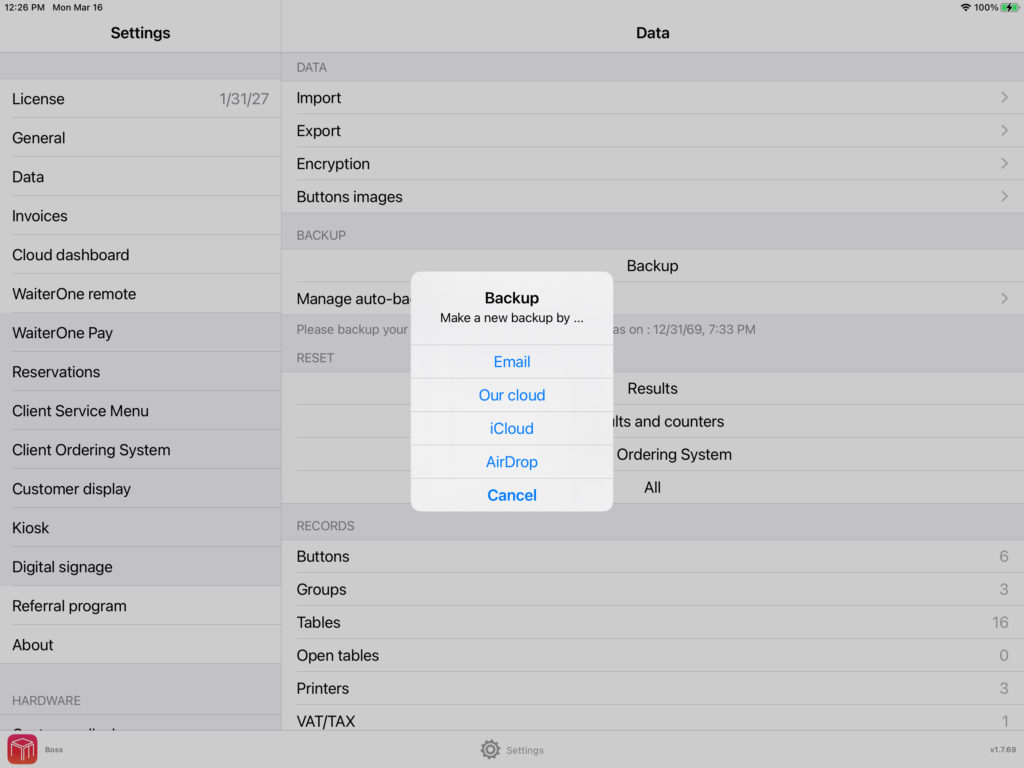
    Settings → Data → Backup

    Create a backup and choose how you want to send it:

    • Email
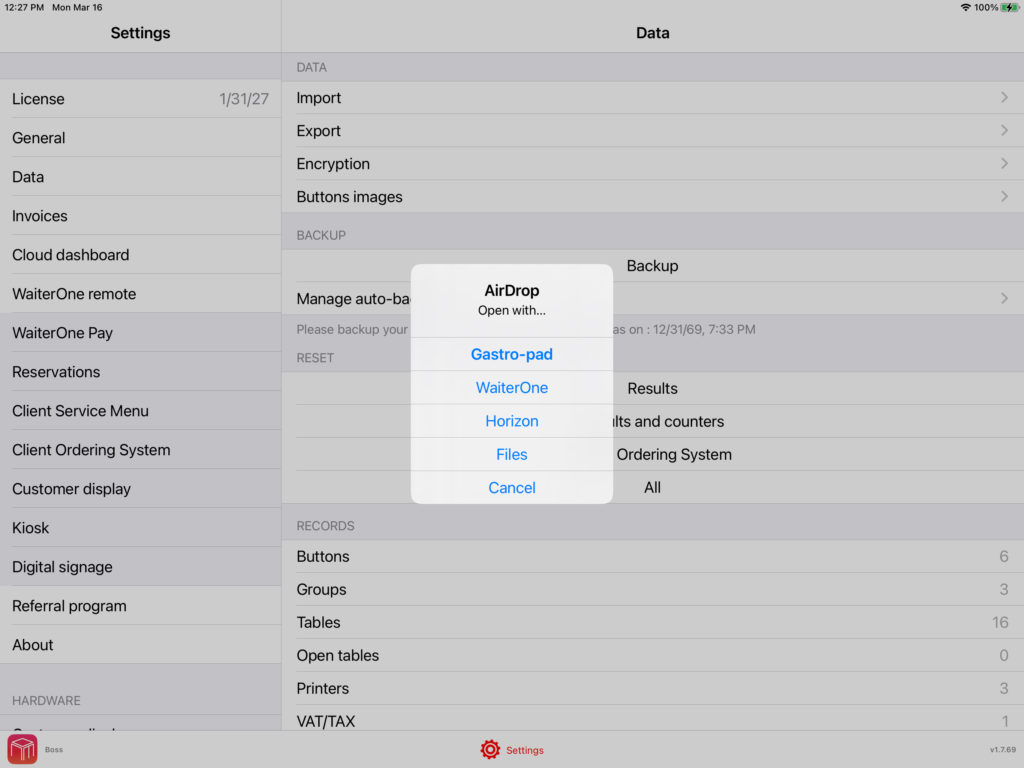
    • AirDrop

    Then send the backup file to your new iPad.

    3. Open the backup on the new iPad

    On the new iPad, receive the backup file and open it in WaiterOne.

    Depending on how you sent it:

    • If you used AirDrop, you can usually open it directly.
    • If you received it by email or saved it in Files, tap and hold the backup file for a moment, then choose Open in WaiterOne or Share to WaiterOne.

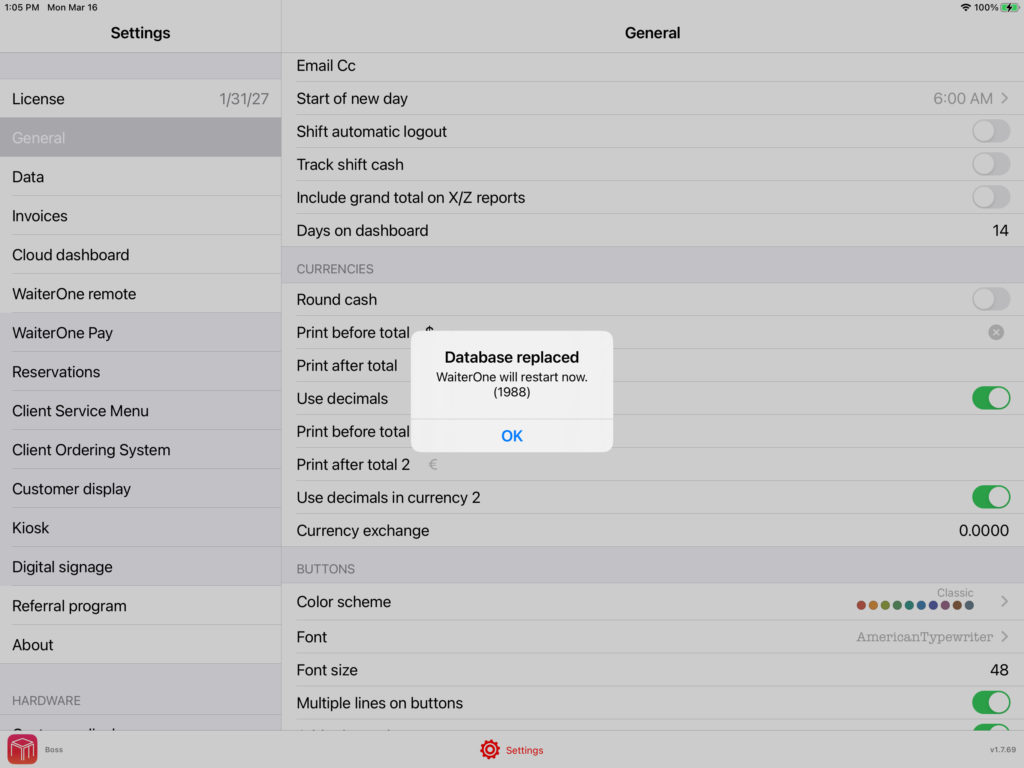
    4. Replace the database

    WaiterOne will ask if you want to replace the current database.

    Confirm this step.

    At that moment, the administrator code should be displayed.

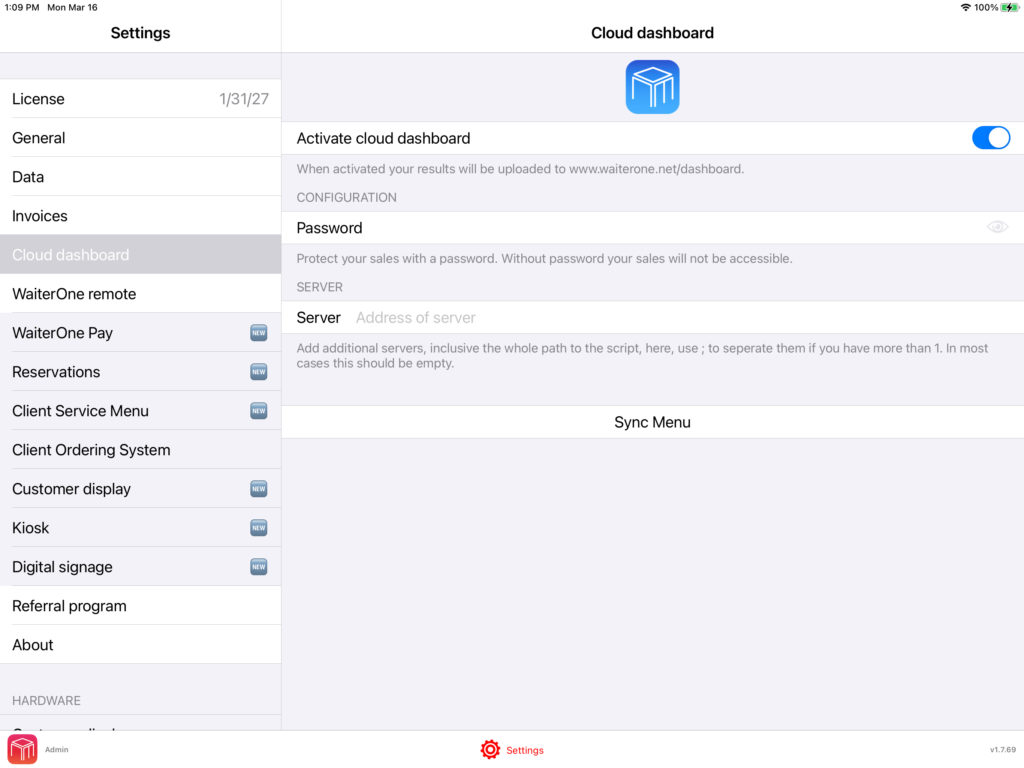
    5. Change your online dashboard password

    After the import, start WaiterOne on your new iPad and go to:

    Settings → Online Dashboard

    Please change your password there.

    This is important because the password is automatically changed after the import. We do this for security reasons, so nobody can know your password if they ever get access to your database.

    6. Contact us to transfer your license

    Once the transfer is complete, contact us so we can move your WaiterOne license to the new iPad.

    If you would also like your historical sales data to be transferred, please let us know as well, since this must be transferred separately.

  • Happy New Year from WaiterOne! 🎉

    Happy New Year from WaiterOne! 🎉

    We’re kicking off 2026 with big ambitions and an even bigger mission: to make staffing for events, festivals, and hospitality faster, simpler, and more profitable.

    At WaiterOne.app, WaiterOne.net and CashierOne.com, we’re rolling out exciting updates that will help you run your business smoother. 

    Thank you for being part of our journey.

    Follow us to stay updated and see how WaiterOne can transform the way you manage your workforce.

    Here’s to a successful, high-impact 2026! 🥂

    #HappyNewYear #WaiterOne #HospitalityTech #EventStaffing #Festivals #WorkforceManagement #SaaS #Innovation #2026

  • Break Language Barriers with WaiterOne POS: Multilingual Support in 18 Languages

    In today’s global hospitality and retail environment, clear communication is key. Whether you’re running a local café in Amsterdam or a bustling restaurant in Bangkok, the ability to serve both staff and customers in their preferred language makes all the difference. That’s why WaiterOne POS offers powerful multilingual support, allowing you to operate smoothly across diverse markets.

    Speak Your Customer’s Language

    WaiterOne POS is equipped to run in 18 different languages, including:

    Chinese, Danish, Dutch, English, French, German, Greek, Italian, Japanese, Norwegian, Polish, Portuguese, Swedish, Russian, Serbian, Spanish, Thai, and Turkish

    This multilingual capability ensures that staff and customers alike can interact with the POS system in a way that feels natural and intuitive no confusion, no guesswork.

    A Game Changer for International Businesses

    For restaurants, cafés, and retail stores operating in multicultural or tourist-heavy areas, multilingual support is not just a bonus it’s a necessity. WaiterOne POS helps businesses:

    • Train international staff more easily
    • Enhance service speed and accuracy
    • Deliver better customer experiences
    • Build trust and loyalty across language lines

    Whether you’re running a tapas bar in Spain, a sushi counter in Japan, or a boutique in Norway, WaiterOne adapts to your team and your clientele.

    Effortless Setup, Seamless Experience

    Languages in WaiterOne POS can be set per device or per user, giving each team member the freedom to use the interface in the language they’re most comfortable with. This flexibility leads to:

    • Fewer mistakes at the point of sale
    • Faster onboarding for new staff
    • Improved team communication
    • A professional, localized service for customers

    Serve Globally, Operate Locally

    WaiterOne’s multilingual support makes it an ideal POS solution for franchise operatorsairport and hotel restaurantsinternational retail, and any business that wants to scale globally while keeping operations smooth locally.


    Ready to Go Multilingual?

    Break through language barriers and deliver world-class service, no matter where you are. Choose WaiterOne POS the smart solution for multilingual, modern businesses.

  • Unlimited Printer Integration at No Extra Cost At WaiterOne POS for Restaurants and Cafés.

    WaiterOne stands out as one of the best POS systems for restaurants and cafés by offering unlimited printer integration at no additional cost. This powerful feature allows restaurant owners to streamline operations, improve order accuracy, and eliminate service delays all without extra fees or licensing.

    Why Unlimited Printer Support Matters for Your Restaurant

    In fast-paced hospitality environments, printing orders to the right location is essential. With WaiterOne POS, you can connect multiple printers across your restaurant from the kitchen to the bar, the counter, or any custom station.

    • Improve kitchen workflow with direct ticket printing
    • Send drink orders instantly to the bar
    • Keep front-of-house staff organized and efficient

    All of this happens automatically and seamlessly, supporting both small cafés and high-volume restaurants.

    No Limits, No Hidden Fees

    Unlike many POS systems that charge per device or printer, WaiterOne includes unlimited printer support by default. There are no monthly add-onsno per-printer charges, and no surprises. This makes it an ideal POS for growing businesses that need flexibility without increased costs.

    Built for Restaurants of All Sizes

    Whether you operate a small coffee shop or a multi-room fine dining restaurant, WaiterOne adapts to your needs. Unlimited printer integration helps:

    • Eliminate order bottlenecks
    • Enhance kitchen communication
    • Speed up service delivery
    • Reduce manual errors

    A Cost-Effective POS System That Scales with You

    WaiterOne POS is more than a point of sale system it’s a complete restaurant management tool. With support for unlimited printers, you gain the ability to scale your operations without worrying about added expenses or configuration limits.

    Optimize Your Restaurant Workflow Today

    If you’re looking for a flexible, scalable, and cost-effective POS system, WaiterOne is the solution. Say goodbye to printer limits and hello to efficient, streamlined service.

  • What’s New in WaiterOne POS for iOS 18


    Automatic E-mail Ticketing
    Tickets can now be emailed directly without manually entering the email address, improving workflow efficiency and reducing errors. This update allows front-end staff to focus more on customer service than email entry.

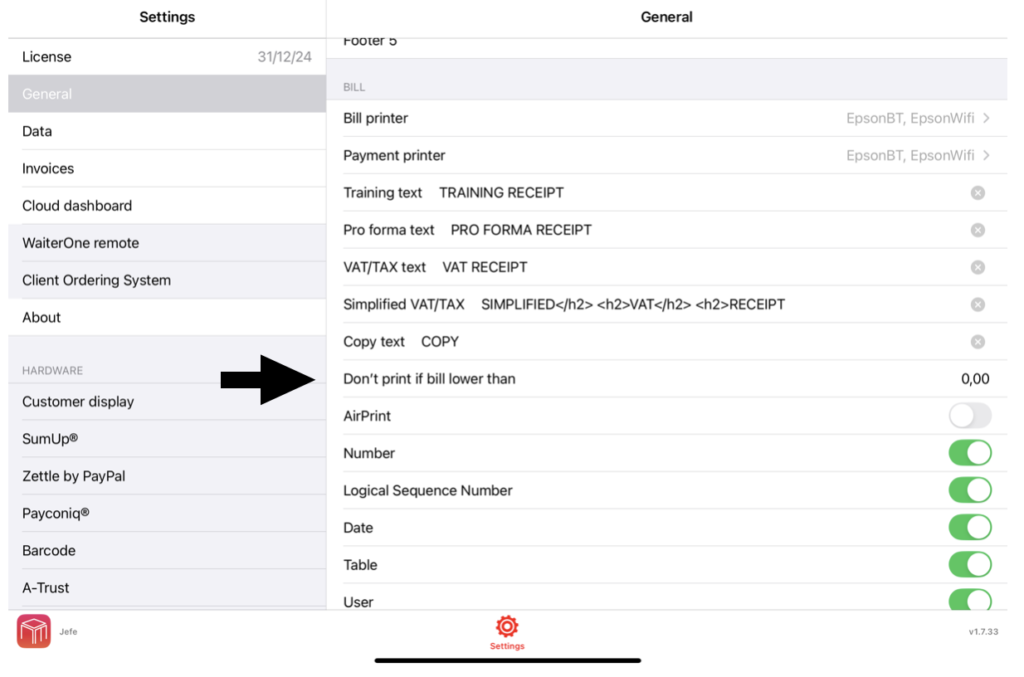
    Flexible Print Options
    WaiterOne POS offers a setting to skip bill printing for transactions below a specified amount, helping reduce paper usage and printing costs. This customizable threshold lets managers tailor billing practices to fit business and environmental goals.

    Remember you can still decide to print the bill. Just press a bit longer (> 1.2 seconds) on the bill button and the ticket will be printed (although the total is less then the minimum to print the bill). Another option is also to ask a copy of a bill, see the tickets button above the order/bill/pay main buttons.

    Improved Product Sorting
    The COS interface now sorts products with numerical names first, followed by alphabetical items. This logical order helps staff locate products faster, especially in large catalogs, improving speed and accuracy during busy hours.

    Payments and VAT/TAX in CSV
    CSV export is now available for Day Payments and Day VAT/TAX reports, allowing easy data transfer for financial analysis. This feature streamlines accounting and enhances reporting by simplifying daily transaction and tax data management.

    Enhanced Reporting

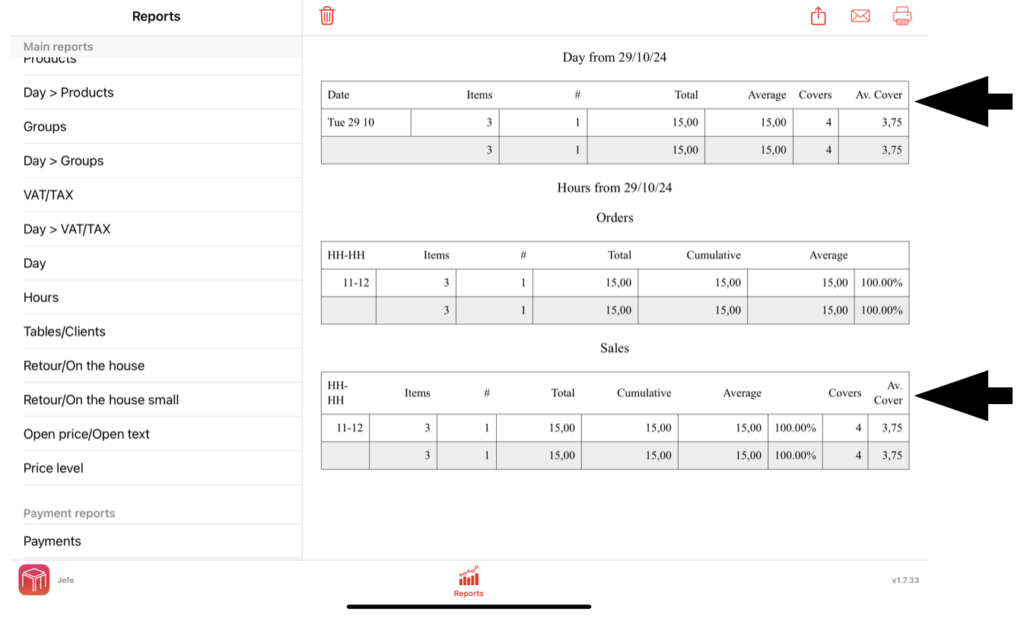
    The Reports section for Day, Hours, and Tables/Clients now includes cover counts, enabling easier tracking and analysis of guest numbers. This update simplifies the assessment of dining trends, service volume, and table turnover.